Will the cash be there?
Follow a borrower's cash, test the timing of a transition investment, and identify the evidence the lending proposal needs.
Start with the cash bridge, transition plans and decision controls.
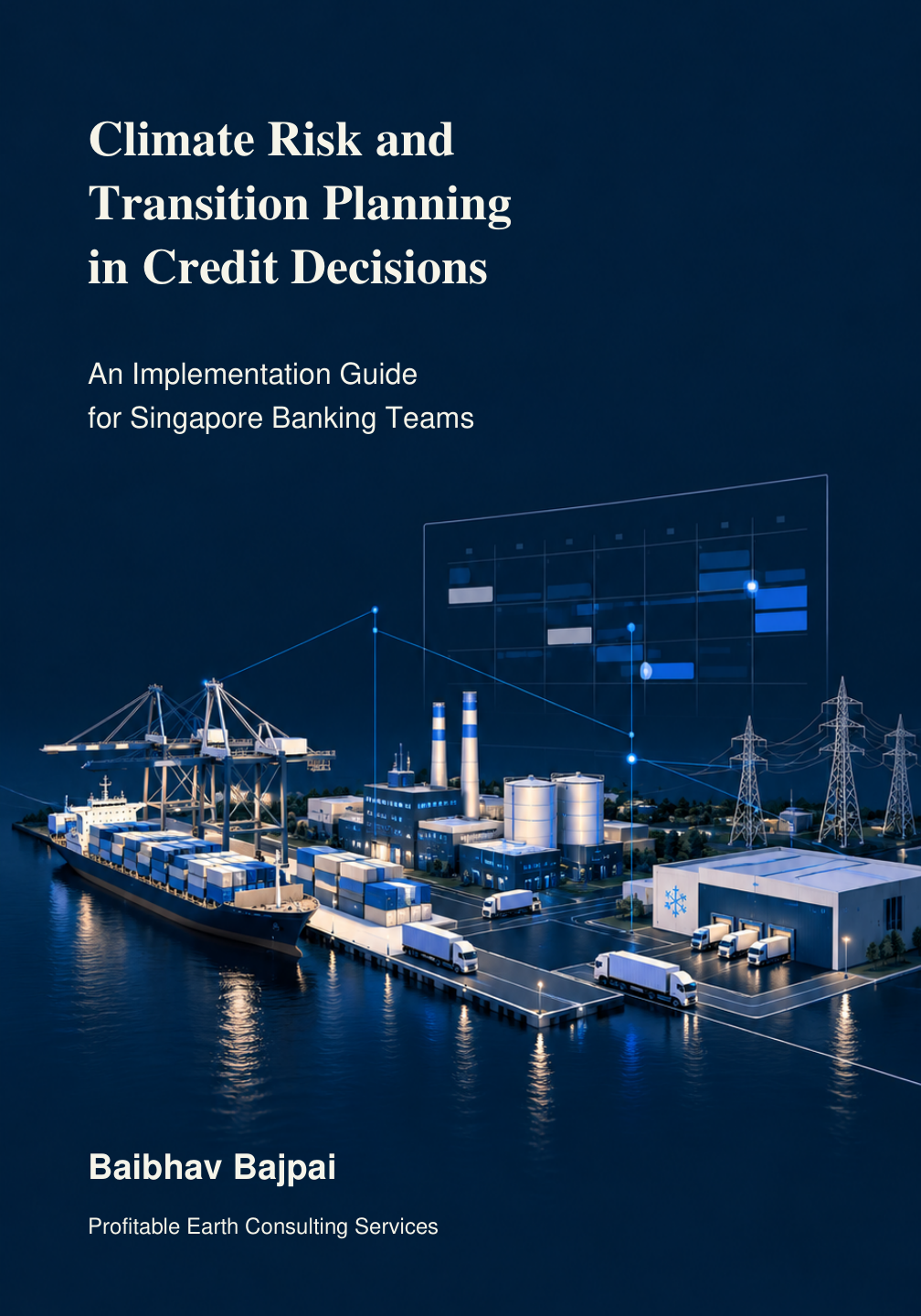
The Profitable Earth book
An Implementation Guide for Singapore Banking Teams
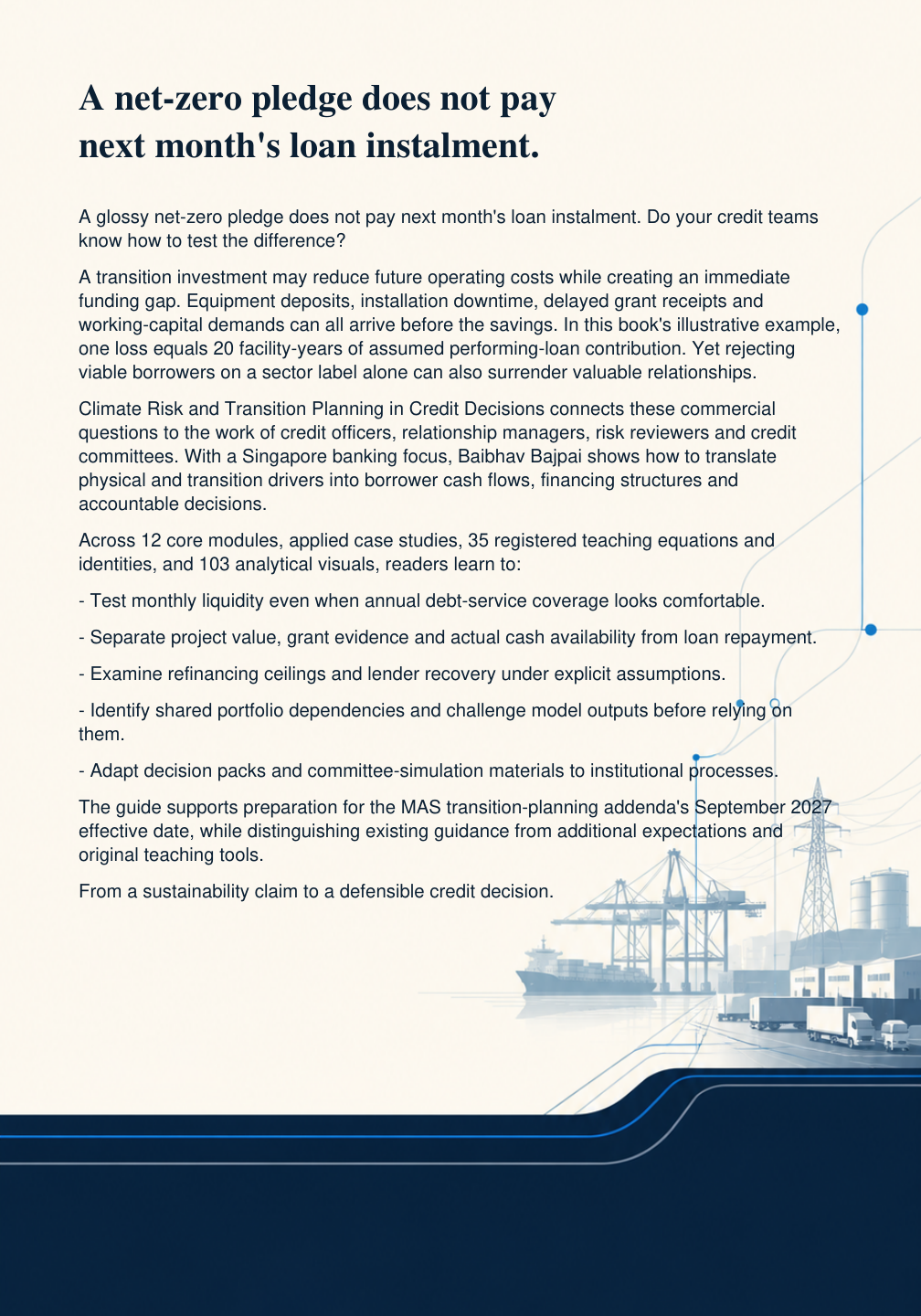
Understand what climate change and transition plans could mean for a business, its cash, and its ability to repay a loan.
Kindle edition · Direct website purchase coming soon
The idea, made simple
A climate statement becomes useful when you can connect it to the business and the lending decision in front of you.
Floods, heat, energy costs, customer needs or a plan to change how a business operates.
Name the specific change.Look at sales, costs, equipment and the people or services the borrower depends on.
Explain the business effect.Put payments, investment, expected savings and loan instalments on the same timeline.
Check the difficult month.Decide what evidence, financing terms, monitoring or further review the case needs.
Record a clear next action.One practical example
A business may want more efficient equipment. The future savings can be useful, while the installation still creates a period when cash is tight.
The book helps you test that period, instead of relying only on a comfortable annual total.
Pay the equipment deposit.
Cash goes outMeet installation costs and possible downtime.
Cash may stay tightCheck whether the expected savings appear.
Benefits may beginA simplified teaching example. Actual costs, funding, savings and timing need evidence for the particular borrower.
Start with the question on your desk
Read from the foundations, or go straight to the examples that help with your current decision.
Follow a borrower's cash, test the timing of a transition investment, and identify the evidence the lending proposal needs.
Start with the cash bridge, transition plans and decision controls.
Distinguish what is known from what is assumed. Ask which uncertainty could change the decision and who owns the next action.
Start with the executive quick start and decision-pack examples.
Look for shared business dependencies, understand the limits of a calculation, and test whether a result answers the right question.
Start with portfolios, model challenge and the technical reading route.
Build the foundations. The three foundation chapters cover credit decisions, historical and policy context, and the language of risk and finance.
These short descriptions explain the reading path. The book contains the full chapter titles, examples, assumptions and source references.
Connect the book with practice
Build your understanding through short questions and learning challenges. Explore the growing learning game, then return to the book for the deeper explanation.
Sign in to play WHYRAFree beta. A Profitable Earth Studio account is required to play.
Your next step
Choose the available purchase option, or register your interest in what comes next.
Visit your Amazon store for the current price and purchase options.
View on Amazon.comOpens Amazon.com in a new tab.
Direct purchase on this website is planned. Register your interest below to hear about availability.
Keep me informedIn Singapore or another country without a listed store? Use Amazon.com. Purchase options depend on your Amazon account's country settings.
Keep learning with Profitable Earth
Register your interest in the book and related learning. Receive occasional updates about the topics you choose.
Guided learning to work through the ideas step by step.
Sessions to discuss the questions and work through practical cases.
Sign in with an email link to show interest and choose your updates.
Loading your preferences…